
Cesium's Plushie Tycoon Guide
Written by Cesium - Version 2004-02-23
Introduction
This guide describes details of the Plushie Tycoon implementation and provides
some of the background mathematical analysis needed to play Plushie Tycoon well.
I am not really qualified to write this guide. I've been playing Plushie Tycoon
for about three weeks. As you read this guide, you will see that there are
numerous areas where I don't know how something works in the game. However, I
haven't seen any Plushie Tycoon guide yet that goes into the same level of
detail as this guide does.
Copyright issues: This document is now firmly in the public domain. I reserve no
rights. If you can figure out a way to profit off this document, feel free. If
you know the answers to any of the questions I raise in this document, or you
have suggestions for better organizations or better details, send me email at
cesium62@yahoo.com.
This guide should only be used as a guide. The rules of the game have been known
to change in the middle of the game. Various details may be changed by the implementers
of the game at any time.
Mechanics
This section discusses the underlying mechanics of the game.
Game Turns
After you start the game, it will take 24 to 48 hours before anything starts
to happen.
There are eight game turns per day. They take place hourly from 10am through 5pm
(these times should be for your local time, which you can set when you start the
game. However, I've only played using California time which is the time zone of
the Neopets servers, and there may be bugs for other time zones).
At each turn update, the prices of raw materials may change. Work is performed
at your factory based on the number of people that were employed at the time of
the game turn. Plushies are shipped to the warehouse. And plushies are sold from
the store.
Note that plushies will move from the factory to the warehouse between 5pm and
9am as well as during normal game turns.
Factory
Your initial factory contains a single assembly line, and your workers can
work on one job at a time. You can queue up a second job to be worked on when
the first job completes (when you expand your factory, I do not know if you receive
additional assembly lines or if you just increase the queue of the number of
jobs that can be worked on at a time).
Your workers are organized into teams. Each team consists of a manager and a
group of workers all of the same type -- dropouts, graduates, trainees, and
journeymen. Up to four teams (one of each type) can work on a single assembly
line at a time.
Warehouse
When the workers finish building all the plushies in a job, the finished
plushies will be shipped to the warehouse. It takes around 10 hours to ship a
job to a warehouse. The game suggests that expanding the warehouse will cause
jobs to be shipped faster. I don't know if expanding the warehouse speed up the
shipping of a single job, or if it allows more jobs to be shipped at the same
time.
Store
Once the job has been shipped to the warehouse, you can click on a button or
two and the job will be immediately moved to your store. Your initial store can
hold two jobs (maybe more?), and the jobs sell in parallel. You receive money
for sold plushies after all the plushies in a job have been sold.
Numbers
In this section, we describe some of the
math behind the game, and some of the numbers that the game has been configured
with.
Basic Strategy
The simple way to think about the game is that you will spend part of your
initial money setting things up: renting and expanding a factory, warehouse, and
store, and upgrading and advertising your store. With the rest of your money,
you will spend part of it on raw materials, and the remainder mostly on labor.
You will move a job through your factory, warehouse, and store where you will
sell the plushies and be given a pile of cash. You will then repeat the
buy-build-sell cycle, hopefully obtaining ever larger piles of cash.
The basic goal of the game, then, is to maximize return on investment in the
shortest period of time. We want each of our buy-build-sell cycles to be as
short as possible, and we want to minimize the buy and build costs for each
cycle.
Setting Up Infrastructure
At the start of the game, you will spend money on each of the following:
- renting your factory
- renting your warehouse
- renting your store
- upgrading your store
- advertising your store
Both upgrading your store and advertising your store appear to affect how many people shop in your store and thus, how fast your plushies sell. I do not know the details as to how much of an affect is obtained from each type and amount of Upgrade or Advertisement. I have been maxing out the first two types of Upgrades (carpets and lighting) and the first three types of advertising (flyers, gifts, and candy).
In order to absolutely maximize your cash flow, you won't buy all the infrastructure at one time, but will buy pieces of the infrastructure in stages:
- Start the game. Click on the button to say you
want to start the game and set your timezone. Then wait 24 hours. While you
are waiting, monitor the prices of raw materials and buy raw materials that
are offered at good prices.
- Rent your factory. If it is between the hours
of 10am and 5pm, wait until 5pm, continuing to monitor the prices of raw
materials.
- Buy raw materials for your job (we will discuss
below how much you can afford to buy).
- Hire emplyees to build your plushies (we will
discuss below the number of emplyees to hire).
- Rent your warehouse. Ideally, you want to wait
until your emplyees are about to finish a job before renting the warehouse,
but being a few hours early or late shouldn't matter. You might want to expand
your warehouse at this time.
- It will probably take all day to build plushies and ship them to your warehouse, so, prior to 10am on the day after you start building plushies, rent your store, upgrade it, and advertise it.
The Sales Price
The sales price of the plushies you build is selected by the game based on
the type of plushie and the materials used to manufacture the plushie.
[This whole subsection is based on analyzing a few different configurations of
plushies, and then wildly extrapolating. This subsection should be treated as
presenting a reasonably plausible theory, but it may be grossly wrong in
details.]
Each type of plushie has a base sales price that is supposed to reflect the
amount of cloth and labor needed to manufacture the plushie. We will assume that
the Base Sales Price is the price for a plushie built with green cloth,
newspaper stuffing, paper packaging, and no accessories. [Most types of plushies
require accessories, but we will pretend that the base sales price doesn't
include the accessories.]
The *approximate* Base Sales Price for some types of plushies is about:
| Species | Base Sales Price NP/Plushie | |
|---|---|---|
| Blumaroo | 2 | |
| Shoyru | 5 | |
| Aisha | 15 | |
| Chomby | 19 | |
| Uni | 22 | |
| Zafara | 72 |
Each improvement in the color of material increases
the sales price by 1NP per plushie. So a red Aisha sells for 3NP more than a
green Aisha.
Each improvement in the type of stuffing increases the sales price by 2NP per
plushie. So a cotton stuffed plushie sells for 6 NP more than a newspaper
stuffed plushie.
For packaging, each improvement basically increases the sales price by 3NP per
plushie, but pretend there is a missing type of packaging between paper and
cardboard. So cardboard packaging adds 6NP to the sales price and Velvet
packaging adds 9NP to the sales price.
For accessories, the sales price multiplier is 13. 'Junk' adds 13NP to the
price, 'plastic' adds 26NP to the price, we pretend there is a missing type of
accessory between 'plastic' and 'rare', and 'rare' adds 52NP to the price.
Selecting Raw Materials
Since our goal is to maximize return on investment, we will select raw
materials in order to meet that goal. Let's suppose that we can build some base
type of plushie for C (cost) NP per plushie, including basic raw materials,
labor, shipping, and rent. And suppose that we can sell that type of plushie for
P (price) NP per plushie. Then the return on investment is "(P-C) / C"
NP per plushie.
In order to decide which color of cloth to buy, we want to choose the color of
cloth that will maximize the (P-C)/C equation. Yellow cloth will increase the
sales price by 1NP. It will increase the costs by the difference in price
between a roll of yellow cloth and a roll of green cloth multiplied by the
number of rolls we need for a plushie. Let's call that incremental cost Cy.
Then, we should buy yellow cloth if "((P+1)-(C+Cy)) / (C+Cy) > (P-C) /
C". This simplifies to: "Cy < C/P".
That is, we should buy yellow cloth if the incremental cost to buy that cloth
instead of green cloth is less than the ratio of the old cost to the old price.
That is: you should almost always buy green cloth. When building plushies that
use a single roll of cloth, you may be able to buy a higher grade of cloth if
the costs increase by less than 100NP from grade to grade. When building
plushies that use 4 rolls of cloth, the costs can only increase by 25NP from
grade to grade (this is just an upper bound. For a profit margin of about 25%,
C/P will be 0.8 and plushies that use 4 rolls of cloth can only increase the
price by 20NP from grade to grade).
The analysis for stuffing is similar. For stuffing, a higher grade can cost up
to 200NP more than the next lower grade and be worthwhile. This usually makes
cotton cost effective.
For packaging, cardboard can be better than paper if it costs less than about
600NP more than paper. Velvet can be better than paper if it costs less than
about 900NP more than paper and about 300NP more than cardboard. Thus, velvet is
almost always the preferred choice.
For accessories, plastic can be better than junk if it costs less than 1300NP
more. Rare gems can be better than junk if they cost 3900NP more, and can be
better than plastic if they cost 2600NP more (since you'll usually be buying
rare gems at under 2000NP, you're always going to want rare gems).
Selecting Plushie Types
When selecting plushie types, we are looking at return on investment per
unit of time. The time it takes to build and sell a plushie includes:
- The time to build a plushie. This is affected
by the complexity of a plushie. Plushies with accessories should take longer
than plushies without accessories, and plushies that use more rolls of cloth
should take longer (in theory, the complexity of each type of plushie is
published. However, there documentation may not accurately reflect the
implementation. At one point in time, I was able to build Zafaras about twice
as fast as Shoyru).
- The time it takes to transport the plushie to
the warehouse. This doesn't depend on plushie type (I assume).
- The time it takes to sell the plushie. Different plushies might have different popularities and some types might sell faster than others.
As an initial strategy, I would suggest worrying
more about the return on investment and less about the cycle time. Plushies that
use accessories are critical to obtaining a good return on investment. More
complicated plushies will generally have a higher base price and thus do a
better job of paying for labor and rent. For these reasons, Zafara appear to be
fairly attractive plushies to build.
Management Strategies
At this point, you have to choose one of two basic strategies for managing
the game. You can be a micro manager and log into the game each hour during the
day to manage your hiring and firing, check on raw material prices, and queue up
new small jobs.
Or you can macro manage and log into the game about once per day.
Micro managing is almost certainly necessary to maximize your score. But how
many of us can afford to spend 40 minutes a day spread out over an eight hour
period every day for four weeks?
When micro managing, you will want to queue up small jobs. And, you will want to
move some jobs through the complete buy-build-sell cycle in under 24 hours. This
means hiring enough workers to complete jobs as fast as possible and then firing
the workers when all jobs are complete. This means expanding the warehouse to
move jobs from factory to store in 6 hours or less. This means advertising and upgrading
your store to move a large volume of customers through the store.
When macro managing, you will be a bit more laissez faire. You will queue up a
small number of jobs. You will hire just enough workers so that all jobs will be
finished by the end of the day without having any idle workers during the last
few hours of the day. You will let plushies move from the factory, through the
warehouse, and to the store in the evening while the factory is idle. And you
will upgrade and advertise your store only enough so that jobs will sell out in
about a day.
Selecting Job Size
When creating a job, small jobs are good because they move through the
system quickly and generate a faster return on investment. However, lots of
small jobs require expanded factories, warehouses, and stores in order to make
parallel the processing of the jobs.
Micro managers will probably want to start a new 100-plushie job every hour or
two. Macro managers will probably want multiple jobs of equal size.
Hiring Workers
As mentioned above, you will be hiring workers to complete jobs in a given
amount of time -- as quickly as possible for micro managers, and within a day
for macro managers.
When hiring workers, you will first be hiring teams. Each team consists of a
manager and some number of workers. The manager's salary is such a large
component of team salary that, once you decide to have a team, you will want the
largest team possible in order to maximize the efficiency of the team.
[The whole "team" concept was implemented in the middle of February
2004. Prior to that, a single manager could manage hundreds of workers. Plushie
Tycoon guides written prior to the code change will suggest hiring few managers
and lots of workers. Similarly, what I've written may be obsolete by additional
code changes by the time you read these words.]
I do not yet know how many of each type of worker can be in a team. For drop
outs, at most 6 workers could be in a team.
Naively, we would expect that as the quality of the worker improves, the less
management we would need and the greater the number of plushies produced by the
team in a given hour. However, I've seen a team of dropouts produce 6 Zafara in
an hour while a team of trainees could only produce 4 Zafara in an hour.
I do not yet know how productive each type of worker is. If we assume that a
Shoyru requires 4 units of work (the documented amount), then it appears that a
drop out can do 2 units of work per hour (however, we will then have to assume
that Zafaras require 2 units of work to produce and that the implementation
doesn't agree with the documentation).
Based on the underlying rules for raw materials, I'm currently assuming the
following table describes employee productivity:
| Type | Unit/Hour | Cost/Hour | Cost/Unit | |||
|---|---|---|---|---|---|---|
| Dropout | 2 | 6 | 3.00 | |||
| Graduate | 3 | 8 | 2.67 | |||
| Trainee | 4 | 9 | 2.25 | |||
| Journeyman | 5 | 12 | 2.40 |
So dropouts are the most efficient worker, and
trainees are the least efficient.
For Team productivity, we have to take into account the maximum size of the
team. The cost of a team includes the cost of the manager for the team.
| Type | Max Size | Unit/Hour | Cost/Hour | Cost/Unit | ||||
|---|---|---|---|---|---|---|---|---|
| Dropout | 6 | 12 | 96 | 8.000 | ||||
| Graduate | 7 | 21 | 116 | 5.524 | ||||
| Trainee | 8 | 32 | 132 | 4.125 | ||||
| Journeyman | 9 | 45 | 168 | 3.733 |
As stated above, the available evidence that I have
does *not* fit the above tables well.
To summarize: hire at most 4 managers per assembly line (the initial factory has
a single assembly line). Each manager can manage about 6 to 10 people depending
on the quality of the employee. Depending on the complexity of the plushie, each
assembly line can produce at most about 20 plushies per hour.
Managing labor costs is critical to making a profit. You cannot let your teams
stand around with nothing to do. Fire your workers and managers when there are
no available jobs. If you won't be able to log into the system and you want some
work to be done, reduce the size of your workforce so that they will finish
their work just before you log into the system.
Cash Management
To achieve the highest scores, you must manage your cash so that you always
have a minimal amount of cash lying around. However, you must remember to
reserve cash to pay the rent, to pay warehouse shipping costs, and to pay for
your one required manager. If your cash goes negative, the game is over.
When cash is low, remember that when rents are due, they are paid when you visit
the building whose rent is due. Also, you won't receive cash from a sold job
until you visit the store. So, when cash is low, visit your store first to get
new money, and then visit places where rent may be due.
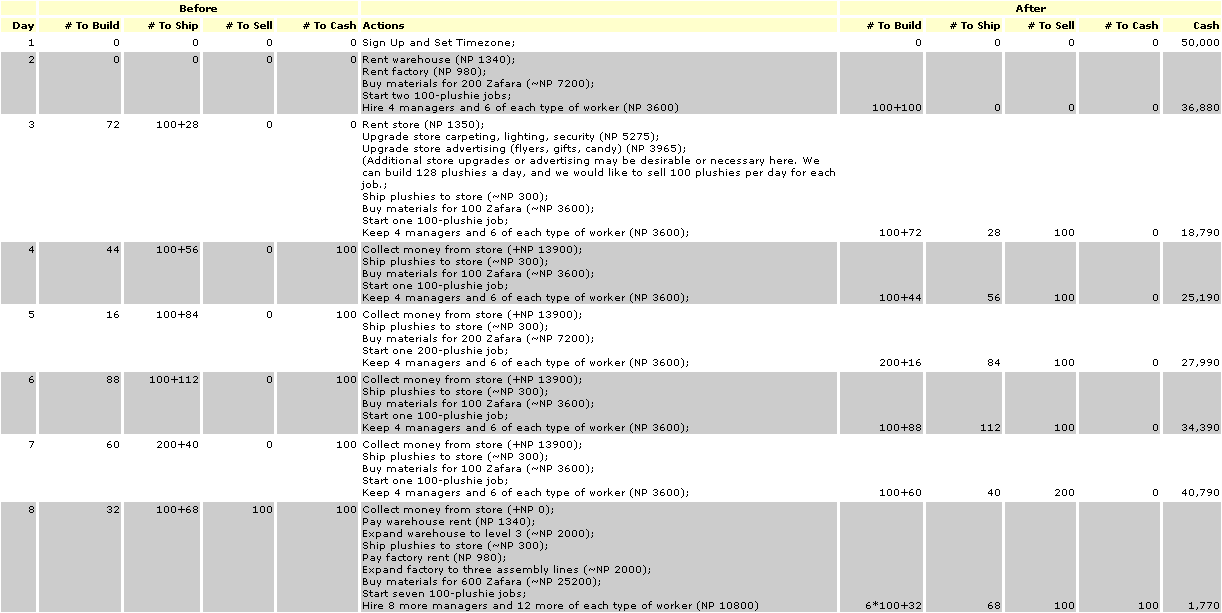
Rough Timeline
In this section, we provide a rough timeline that displays, approximately, the
cash flow involved in a game. This provides an example of managing the game and
a benchmark against which to measure your game. This timeline assumes that all
actions take place at 9am. When raw materials are noted as being purchased, they
may, of course, be bought at any earlier time if prices are low (and sufficient
funds are available).
On each day, we perform the following actions:
- Visit store. Pay rent, collect money from
finished jobs. Upgrade and expand.
- Visit warehouse. Pay rent, ship any jobs to the
store that are ready, expand.
- Visit factory. Pay rent, upgrade and expand.
- Buy raw materials. (If not already bought.)
- Hire additional emplyees.
Our basic strategy here is to sell 100 to 200
Zafara per day for the first week. During the first week, we will have one
assembly line operational, which will limit us to producing around 128 plushies
per day. For the second week, we will expand the factory to support 3 assembly
lines. By the third week, we should have maximally expanded our factory.
The above is probably inaccurate and does not use funds efficiently. Describing a strategy in further detail will require additional experience with multiple assembly lines, more experimentation with optimal hiring patterns, and more analysis of the trade offs of expanding the various buildings.














Neopets Departments